
 Español
 Português
Young chimpanzees develop population/community-specific accents
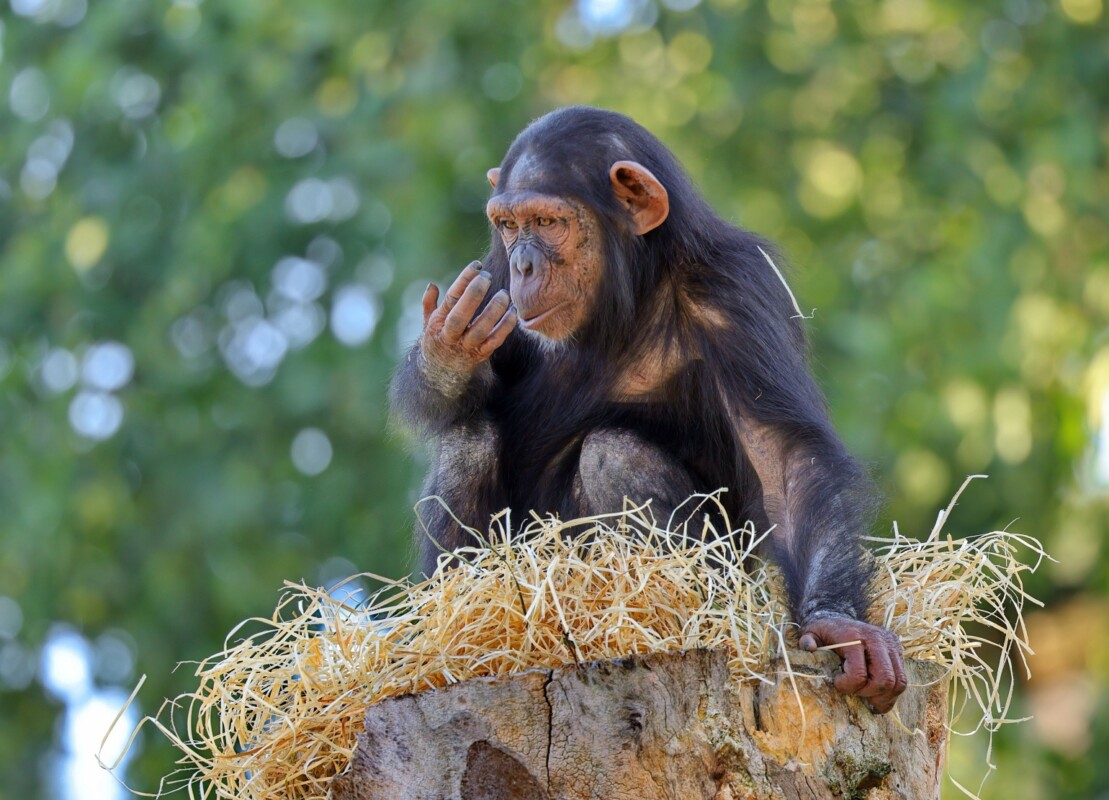 Caption: Young chimpanzee (Pexels - Karel Drozda)
A study published in September 2026 in the scientific journal PLOS ONE reveals that infant and juvenile chimpanzees develop distinct vocal accents depending on the group in which they live. Analyzing grunts, whimpers, and laughs helped researchers identify that chimpanzee accents differ across populations/communities.
The analyses of the three types of vocalizations were conducted on a sample of 31 infant and juvenile eastern chimpanzees from two geographically separated populations. One group lived in Gombe National Park, Tanzania, while the other lived at the Chimfunshi Wildlife Orphanage, Zambia.
Across all three types of vocalization, researchers found acoustic differences associated with where the chimpanzees lived; and identification became significantly more accurate among juveniles. Grunts and laughs contained clues about the population they belonged to from early in life, whereas infant whimpers did not. This distinction only appeared during the juvenile years.
The study therefore concluded that young chimpanzees develop vocal patterns specific to each population, and these become more recognizable as individuals mature. The analysis results challenge the idea that chimpanzee vocalizations are entirely determined by genetics. Instead, vocal traits can also be shaped by peers and the environment.
“Understanding how communication develops early in life is critical to understanding animal behavior,” said the study’s lead researcher, Kassandra Giragosian. “Our findings show that chimpanzee vocalizations are not simply fixed from birth, but continue to develop as young animals interact with their social and ecological environments.”
Study: “Ontogeny of dialects across chimpanzee vocalisations”
https://journals.plos.org/plosone/article?id=10.1371/journal.pone.0355313
News - More News
The NIH Has Decided to Move Its Last Group of Retired Research Chimpanzees to an Animal Sanctuary Next Year

NGOs Issue Red Alert for the Tapanuli Orangutan

Defying conflict to track the world’s rarest chimpanzees

Overlooked breadth of chimpanzee culture

Children and Monkeys Share a Common Understanding of Geometry

Residents' Stories
Yoko and His Hat: Environmental Enrichment, Stimulation, and Well-Being


Origin: Biopark Ukumari (Colombia)
Sanctuary: Sorocaba, São Paulo/Brazil
Longevity and Quality of Life


Origin: Chimpanzee Breeding Marco Schwartz (PR)
Sanctuary: Sorocaba, São Paulo/Brazil
The social integration process of #chimpYoko has advanced!

Origin: Biopark Ukumari (Colombia)
Sanctuary: Sorocaba, São Paulo/Brazil
The GAP Project
GAP is an international movement whose main objective is to fight for the basic rights to life, liberty and non-torture of non-human great apes - Chimpanzees, Gorillas, Orangutans and Bonobos, our closest relatives in the animal kingdom.
Development and Hosting