
 Español
 Português
NGOs Issue Red Alert for the Tapanuli Orangutan
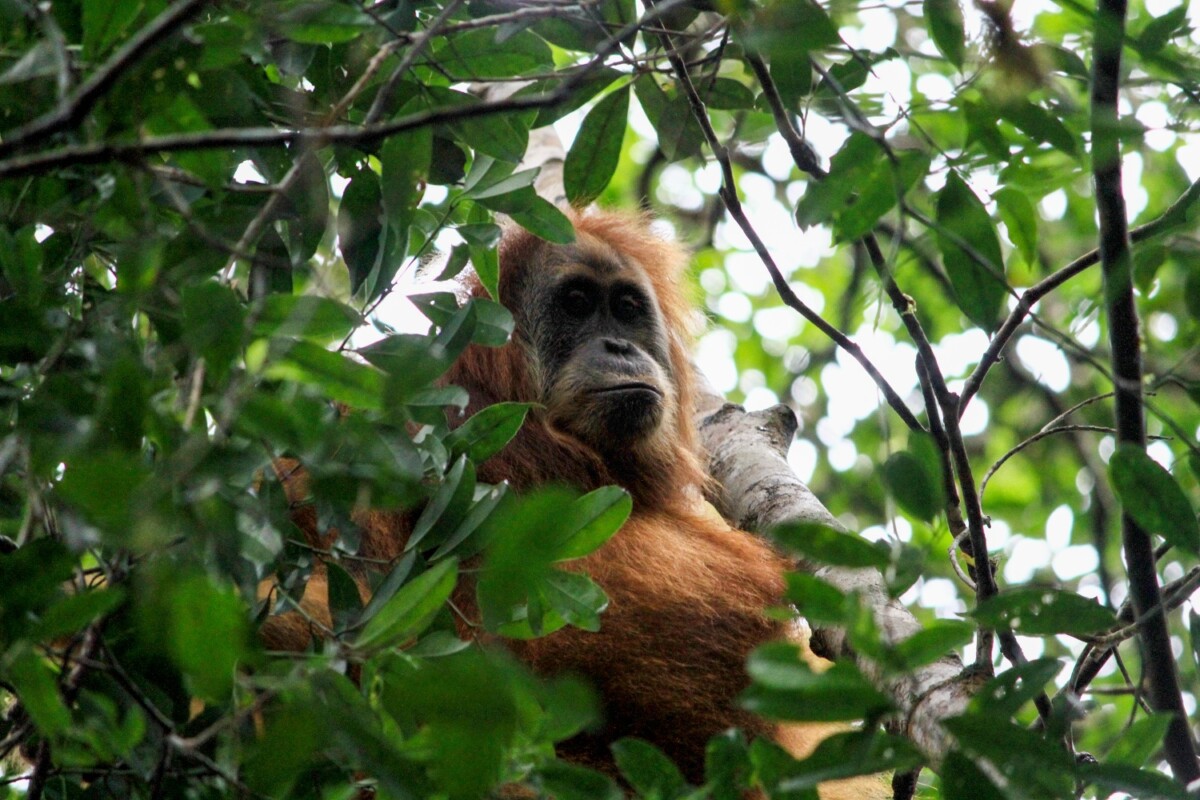 Caption: Orangutan Tapanuli (Prayugo Utomo, CC BY-SA 4.0, via Wikimedia Commons)
The environmental organizations Mighty Earth and Satya Bumi released a Red Alert report on the Tapanuli orangutan at the end of October, during COP17 of the CBD (the United Nations Convention on Biological Diversity Conference of the Parties) in Yerevan, Armenia.
The report “Code Red for the Tapanuli Orangutan” highlights the risk that the species could disappear if an immediate recovery effort—involving all actors and agents responsible for protecting and conserving its habitat—is not put into practice. In other words, the organizations are calling for urgent collective action.
The Tapanuli orangutan was officially described by scientists only recently, in 2017, despite having been observed since the 1930s. The species was named after the Tapanuli region, south of Lake Toba, in North Sumatra Province (northwestern Sumatra, Indonesia). The Tapanuli orangutan’s habitat has a significant history of deforestation impacts and the effects of ongoing climate change.
Living in a restricted area already heavily threatened by human activity means the Tapanuli orangutan was “born” facing a serious risk of extinction. Estimates made before the climate disaster of severe floods and landslides that struck the region in November 2025 counted a total of 716 individuals in the wild. After the disaster, a modeled estimate projected 58 potential deaths. As a result, the report estimates that only 658 individuals remain in the forests today.
The case of the Tapanuli orangutan is a clear test of one of the key commitments discussed by member countries under the Convention: to halt human-caused extinctions of threatened species and support their recovery. Identified as a distinct species less than a decade ago, the Tapanuli orangutan represents a unique evolutionary lineage that survived for millions of years but now faces an uncertain future.
News - More News
Defying conflict to track the world’s rarest chimpanzees

Overlooked breadth of chimpanzee culture

Children and Monkeys Share a Common Understanding of Geometry

Great apes: what we know about their cognition, cooperation and curiosity after two decades of research

Study demonstrates long breastfeeding periods in orangutans

Residents' Stories
Yoko and His Hat: Environmental Enrichment, Stimulation, and Well-Being


Origin: Biopark Ukumari (Colombia)
Sanctuary: Sorocaba, São Paulo/Brazil
Longevity and Quality of Life


Origin: Chimpanzee Breeding Marco Schwartz (PR)
Sanctuary: Sorocaba, São Paulo/Brazil
The social integration process of #chimpYoko has advanced!

Origin: Biopark Ukumari (Colombia)
Sanctuary: Sorocaba, São Paulo/Brazil
The GAP Project
GAP is an international movement whose main objective is to fight for the basic rights to life, liberty and non-torture of non-human great apes - Chimpanzees, Gorillas, Orangutans and Bonobos, our closest relatives in the animal kingdom.
Development and Hosting