 Español
 Português
New chimpanzee welfare finding is made in Brazil
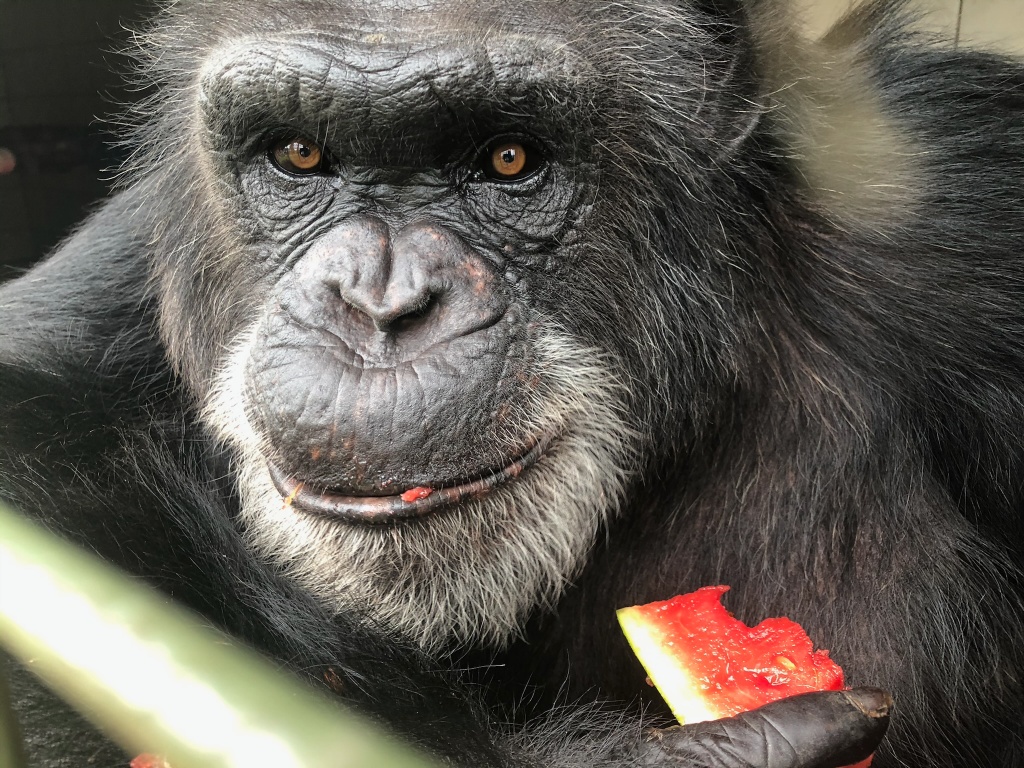 Caption: Chimp Noel was one of the chimps observed during the study (Photo: Dr. Juliana Kihara)
By Jaqueline B. Ramos
A field study conducted at the Great Apes Sanctuary of Sorocaba, in the countryside of São Paulo, Brazil, uncovered significant finding for evaluating the welfare of captive chimpanzees. According to the study’s author, veterinarian Juliana Kihara, existing theoretical frameworks suggested that less-stressed chimpanzees show a preference for using their right hand, while more stressed individuals favor the left hand, which is linked to the brain’s right hemisphere. However, her observations showed chimpanzees displaying signs of stress behavior using their right hand.
“Therefore, we preliminarily concluded that lateralization is not a reliable indicator of welfare and that it needs to be studied further,” says the veterinarian, whose research was part of her recently completed Master’s degree in Animal Behavior at the Federal University of Rio Grande do Norte (UFRN).
Dr. Kihara worked for 12 years (2013–2025) at the Great Apes Sanctuary of Sorocaba, one of the institutions affiliated with the Great Ape Project Brazil/International and currently the largest facility in Latin America dedicated to the rescue, rehabilitation, and lifelong care of chimpanzees. The sanctuary currently houses 42 chimpanzees, all rescued from situations of abuse in circuses, zoos, and commercial activities.
Welfare and individual differences
Over a four-month period in 2023, Dr. Kihara carried out behavioral observations of 41 chimpanzees, aged between 6 and 55 years. There were six half-hour focal sessions for each individual and group scans every five minutes. The goal was to understand how two key welfare indicators—space use and brain lateralization—could be influenced by individual differences (personality), as well as by age, sex, origin (where they lived before arriving at the sanctuary), maternal rearing (whether they were raised by a chimpanzee mother, a human, or if this information was unknown), and current social conditions (living alone or with others).
“Space use” refers to the diversity of an individual’s use of the enclosure—whether they concentrate in a specific area or explore multiple zones. “Brain lateralization” refers to hemispheric asymmetry (each side of the body being controlled by the opposite brain hemisphere) and the differing functions of the right and left hemispheres—the right being linked to strong negative emotions such as fear or aggression. Thus, it was observed hand preference during relaxed behaviors (eating, scratching, or manipulating objects) to determine each chimpanzee’s lateralization.
Some preliminary results confirmed existing expectations. For example, chimpanzees raised by humans in early life tended to show more solitary and neurotic behaviors, especially males. Meanwhile, chimpanzees coming from backgrounds without public display (circuses or zoos) tended to be less neurotic, more extroverted, and more agreeable, hence more sociable. It was also confirmed that individuals exhibiting greater stress behaviors showed less variety in their use of space.
The most surprising results, however, were those related to lateralization, which differed from previous research. “My observations show that dominant chimpanzees and those less open to new experiences use their left hand more often, whereas those displaying higher stress levels use their right hand more,” notes Dr. Kihara.
The finding that stress can correlate with right-hand use contradicts what had been believed by the scientific community and opens new perspectives for studying chimpanzee behavior and welfare in captivity. “In fact my observation showed that the more stressed chimps were really using their right hand. This suggests that hand preferences are way more complex that we thought”, she points.
Brazilian study highlighted at international congress
Juliana Kihara was the only Brazilian professional specializing in the clinical care of captive chimpanzees invited to present field research results at the International Primatological Congress, held in July 2025 in Madagascar. The biennial event is organized by the International Primatological Society (IPS).
She presented her findings in the Symposium on Advances in Nonhuman Primate Welfare, led by the IPS Committee on Captive Care and Welfare. The event brought together renowned primatologists from across the world and served as an important forum for discussing welfare-related topics relevant to various institutions.
Sharing her research internationally, even in the form of preliminary results, was a milestone opportunity to showcase the dedicated work of Brazilian sanctuaries caring for chimpanzees rescued from diverse forms of exploitation—and to highlight the importance of behavioral monitoring and evaluation for improving welfare standards.
“I believe we now have a new path ahead to inspire more research on great apes in Brazil, as well as to demonstrate the importance of sanctuary work. Sharing our knowledge and findings is essential to nurture our society and to keep improving our efforts,” concludes Dr. Kihara.
Gallery of Images and Videos
News - More News
Like humans, chimpanzees are fascinated by crystals

Bonobos are capable of pretend play, just like human children

Chimpanzees change their minds based on evidence, demonstrating, like us, rational thinking

The Wound of Forgetfulness

Rest in Peace, Dr. Jane Goodall (1934-2025)

Residents' Stories
The social integration process of #chimpYoko has advanced!


Origin: Biopark Ukumari (Colombia)
Sanctuary: Sorocaba, São Paulo/Brazil
Overcoming difficulties


Origin: Le Cirque Circus
Sanctuary: Sorocaba, São Paulo/Brazil
Companionship that heals


Origin: Sorocaba zoo
Sanctuary: Sorocaba, São Paulo/Brazil
The GAP Project
GAP is an international movement whose main objective is to fight for the basic rights to life, liberty and non-torture of non-human great apes - Chimpanzees, Gorillas, Orangutans and Bonobos, our closest relatives in the animal kingdom.
Development and Hosting