
 Español
 Português
Like humans, chimpanzees are fascinated by crystals
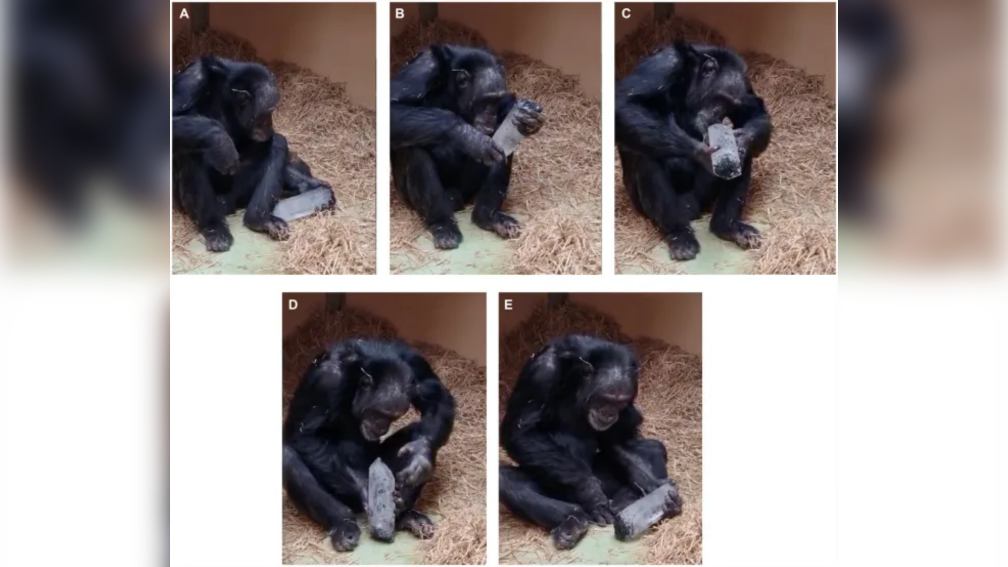 Caption: Chimpanzee Toti was one of the chimpanzees observed in the study.
A study published earlier this month in the scientific journal Frontiers in Psychology suggests that chimpanzees share with humans a fascination for crystals. The study was conducted with nine chimpanzees monitored at a rehabilitation center in Spain and shows that, beyond identifying crystals, the chimpanzees clearly expressed interest in handling and comparing them.
The study’s general idea is to understand why humans ancestrally are fascinated by crystals, by comparing chimpanzees, our closest evolutionary relatives, behavior in relation to them. Scientifically documented evidence reports that some of the first objects collected and kept, with no evident utility, by our hominins ancestors were small quartz and calcite crystals.
This behavior, dated back 780,000 years ago, is interpreted as early evidence of symbolic thought. According to the researchers, the study took an experimental approach to investigate the reasons behind ancestral fascination with crystals.
A series of experiments with enculturated chimpanzees (a technical term for individuals living under human influence, i.e., not fully wild) was designed to identify which physical properties of crystals might have attracted chimpanzees and hominins. The results suggest that chimpanzees can identify and distinguish crystals from other types of stones, and that transparency and geometric shape were the two main attractors.
Additionally, the crystals elicited exploratory behaviors in the chimpanzees, who engaged in voluntary and intentional actions to investigate crystalline transparency and compare shapes.
The full study can be accessed for free at https://www.frontiersin.org/journals/psychology/articles/10.3389/fpsyg.2026.1633599/full#sec27.
News - More News
Bonobos are capable of pretend play, just like human children

New chimpanzee welfare finding is made in Brazil

Chimpanzees change their minds based on evidence, demonstrating, like us, rational thinking

The Wound of Forgetfulness

Rest in Peace, Dr. Jane Goodall (1934-2025)

Residents' Stories
The social integration process of #chimpYoko has advanced!


Origin: Biopark Ukumari (Colombia)
Sanctuary: Sorocaba, São Paulo/Brazil
Overcoming difficulties


Origin: Le Cirque Circus
Sanctuary: Sorocaba, São Paulo/Brazil
Companionship that heals


Origin: Sorocaba zoo
Sanctuary: Sorocaba, São Paulo/Brazil
The GAP Project
GAP is an international movement whose main objective is to fight for the basic rights to life, liberty and non-torture of non-human great apes - Chimpanzees, Gorillas, Orangutans and Bonobos, our closest relatives in the animal kingdom.
Development and Hosting